Mold on Ceiling After Leak? Help for Torrance Homes
Dark spots or a musty smell after a leak mean the ceiling stayed wet too long. Here’s what to do, what not to do and how we fix it.
What should you do about mold after a ceiling leak?
Stop the water and dry the area fast.
Call (424) 390-0246Free inspection · Emergency line 24/7
The EPA advises drying wet materials within 24 to 48 hours to help prevent mold. Small surface spots can be cleaned. Moldy drywall should be cut out and replaced.
Key points
- 1Never paint over mold.
- 2The EPA suggests areas over about 10 square feet may need professional help.
- 3A musty smell often means hidden growth.
Why Mold Follows Leaks
Mold is a fungus that grows when its spores find moisture and food. A leak supplies both. Spores are everywhere, indoors and out.
A wet ceiling gives them both. Drywall paper, wood framing and dust in the insulation are all food. The EPA advises drying wet materials within 24 to 48 hours to help prevent mold growth. After that, the odds climb fast.
So mold on ceiling after leak damage is common, especially when the water went unnoticed. We see it most after slow bathroom leaks, attic AC overflows and roof leaks that dripped for weeks.
The good news? Small areas can often be handled simply. Larger areas need more care. This page walks you through both.
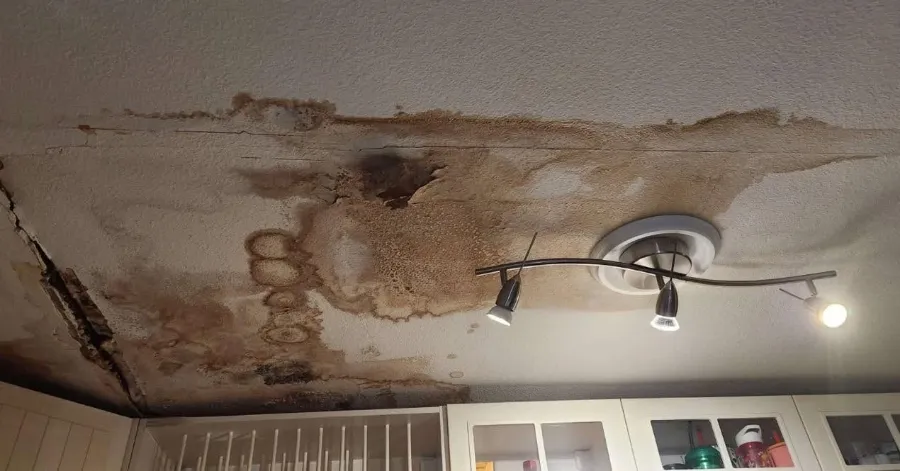
Signs of Mold on Ceiling After Leak Damage
The main signs are small dark spots, a musty smell and stains that stay damp. Mold doesn’t always look like a big black patch.
- Small gray, black or green spots. Often speckled or fuzzy, sometimes in a cluster.
- A musty, earthy smell. Many people smell it before they see it.
- Spots that come back after cleaning. Surface cleaning won’t reach growth in the board.
- A stain that stays damp. Moisture that won’t dry is a mold risk.
- Discolored paint or soft board. Especially around an old leak spot.
Not every dark spot means mold after a leak. Soot, dirt and old stains can look similar. That’s where mold testing can help if you’re unsure.
Mildew or Mold? Surface or Deep?
Mildew is surface growth on the paint that often wipes off. Mold is growth inside the drywall that usually has to be cut out.
Surface mildew sits on top of paint. It’s common on bathroom ceilings with poor ventilation. It often wipes off, then returns if the room stays humid.
Mold in the material grows into the drywall paper, the gypsum or the framing above. Cleaning the surface won’t solve it. The affected material usually has to come out.
A simple check helps. If the board under the spot is soft, stained through or damp, the growth is likely deeper. Is the board firm and dry, with spots only on the paint? Then it may be surface growth.
For bathroom ceilings, fix the ventilation too. Our page on ceilings below leaking bathrooms covers steam and exhaust fans.
| Sign | More likely surface growth | More likely deeper growth |
|---|---|---|
| Look | Gray or white and powdery | Black, green or fuzzy patches |
| Size | A small spot | Larger than about 10 square feet |
| Board | Firm when pressed | Soft, stained through or crumbly |
| Smell | Faint or none | Strong and musty |
What We Do About Ceiling Mold Removal
Ceiling mold removal for small areas is part of our repair work. For large areas, a mold specialist should be involved.
Find and Stop the Moisture
Stopping the moisture always comes first, because mold comes back if the water does. We confirm the leak is fixed and the area is drying before anything else.
Contain the Area
We isolate the work area to keep spores and dust from spreading. Then the damaged section comes out carefully.
Remove Affected Material
Moldy drywall and insulation are cut out and bagged. We check the framing above for growth and moisture.
Rebuild and Seal
Once the area is clean and dry, we hang new board and finish it. A stain blocking primer goes on before paint. See drywall ceiling patches and panels for how that works.
When to Bring in a Mold Specialist
Bring in a mold specialist when growth covers more than about 10 square feet. Larger ceiling mold removal jobs need more than a patch. The EPA suggests that areas larger than about 10 square feet may need professional guidance.
Consider mold testing or a specialist when:
- The moldy area is larger than about 10 square feet.
- You smell mold but can’t find it.
- The leak lasted weeks or months.
- Someone in the home has asthma, allergies or a weakened immune system.
- You’re buying or selling the home and need documentation.
We’ll tell you plainly if a job is beyond a ceiling repair. In those cases, a remediation company handles the mold first. We handle the ceiling rebuild after. Our guide on who to call for a ceiling leak explains how the trades fit together.
What Not to Do
Don’t paint over mold, sand it or mix cleaners. These common moves make mold problems worse.
- Don’t paint over it. Paint hides it for a while. The growth continues underneath.
- Don’t dry scrape or sand it. That spreads spores through the house.
- Don’t mix cleaners. Never mix bleach with ammonia products. The fumes are dangerous.
- Don’t close up wet materials. New drywall over damp framing invites mold back.
- Don’t wait for it to go away. It won’t while moisture remains.
With mold on ceiling after leak damage, the safest first step is simple. Stop the water and keep the area dry.
The key to mold control is moisture control.
U.S. Environmental Protection Agency, Mold
Ceiling Mold in Torrance Homes: Local Factors
Torrance’s coastal climate plays a part in ceiling mold. The marine layer keeps humidity high on many mornings, especially closer to the coast, and moisture builds up fast in bathrooms without a working exhaust fan. When a small leak adds water to that mix, ceiling mold in Torrance homes can appear within days.
We see a few patterns again and again. Bathrooms below or beside showers develop mold in the ceiling corners. Attic condensation around poorly insulated ducts shows up as spotty mold on bedroom ceilings. Older homes with plaster ceilings can hide mold behind paint layers until a stain or bubbling appears. Rainy-season roof leaks, usually between November and March, are another common cause.
For a small patch on a painted surface, cleaning and fixing the moisture source may be enough. Anything larger, or mold inside the ceiling cavity, should be handled by a qualified remediation specialist first. Once the area tests dry and clean, we rebuild the ceiling, seal any staining and match the texture and paint.
Mold on Ceiling Drywall: Clean It or Replace It?
A few small spots of mold on ceiling paint, usually in a bathroom, can often be cleaned with detergent and water once the moisture problem is fixed. Wear gloves and eye protection and keep the room ventilated.
Ceiling mold removal gets bigger when the mold is inside the cavity or covers a large area. In that case the affected drywall and insulation are removed, the framing is cleaned and dried, and the ceiling is rebuilt.
Attic mold often shows up on the ceilings below as small gray or black spots. It usually comes from bath fans venting into the attic or roof leaks. Fixing the ventilation stops it from coming back.
Mold on Ceiling: What the Colors Usually Mean
Mold on ceiling drywall does not always look the same. Color alone cannot tell you how risky it is, but it can hint at how long moisture has been there.
- Gray or black specks often mean steady moisture over weeks.
- Green or white fuzz can show up early, within days of a leak.
- Pink or orange film is common in humid bathrooms and is usually surface growth.
- Brown rings without fuzz are more often a water stain than mold.
Testing is the only way to know the type for sure. Either way, the moisture source has to be fixed first.
Black Spots on Bathroom Ceiling
Black spots on bathroom ceiling paint are very common in rooms without a strong exhaust fan. Small surface spots can often be cleaned, and better ventilation keeps them away. Spots that return quickly, spread past a small patch or sit over a soft area usually mean moisture is inside the drywall, and the board needs to be replaced.
FAQ · Answers from local pros
Ceiling Mold Questions
These short answers cover what Torrance homeowners ask most about mold after a leak.
These short answers cover what Torrance callers ask most. Office hours are Monday to Friday, 8:00 AM to 5:00 PM, and our emergency line is open 24/7. Give us a call
How fast does mold grow on a wet ceiling?
It can start within 24 to 48 hours in wet materials, according to the EPA. Warm, still air speeds it up. That’s why fast drying matters so much.
Can I clean mold off my ceiling myself?
Small surface spots on a firm, dry ceiling can often be cleaned with detergent and water. Wear gloves and eye protection. If the board is soft or the area is large, it’s time for a professional.
Do I need mold testing?
Usually not. If you can see the growth and the source is known, removal often comes first. Testing helps when you smell mold but can’t find it, or when you need documentation.
Will insurance cover mold on my ceiling?
It depends on your policy and the cause of the leak. Some policies cover mold from a sudden, covered leak. Many limit or exclude it. See our guide on insurance claims for ceiling leaks.
Is ceiling mold dangerous?
It can be for some people. Mold can trigger allergies and asthma symptoms, according to the EPA. Anyone with health concerns should talk to a doctor and avoid disturbing the area.
What are the black spots on my ceiling?
Black spots on a ceiling are usually mold or mildew. Spots near a shower are often mildew from steam. Spots around a stain point to mold from a leak above.
Is ceiling mold common in Torrance’s coastal climate?
It’s fairly common, especially in bathrooms and rooms without good ventilation. Higher humidity near the coast means a small leak or poor ventilation can lead to ceiling mold faster than in drier inland areas.
Who handles ceiling mold removal in Torrance?
Visible mold larger than a small patch should be removed by a licensed mold remediation company. After they clear the area, we repair or replace the damaged ceiling and match the finish.
Is mold on the ceiling dangerous?
It can trigger allergies and asthma, especially in kids and sensitive people. Small areas can be cleaned, but larger growth or mold inside the ceiling should be handled by a professional.
Why does mold keep coming back on my bathroom ceiling?
Usually because moisture keeps building up. A weak or missing exhaust fan, or a fan that vents into the attic, lets steam condense on the ceiling after every shower.
If this sounds familiar, see also how long a wet ceiling takes to dry, ceiling repair after water mitigation and popcorn ceiling asbestos testing.
Free inspection · Torrance, CA
Get the Mold Out and the Ceiling Back
Mold on ceiling after leak damage means water stayed too long. Let’s stop it, remove what’s affected and rebuild it clean.
We handle ceiling mold removal and rebuilds after leaks across Torrance and nearby South Bay cities. Call us for a free inspection. For everything we do, visit our ceiling water damage repair Torrance page.
Talk to a ceiling pro now
- Open 24/7 for emergencies
- Free inspection and written estimate
- Leak source found before we patch
- Serving all of Torrance and the South Bay
No obligation. Emergency calls answered 24/7.